

SACKLERS GET SACKED
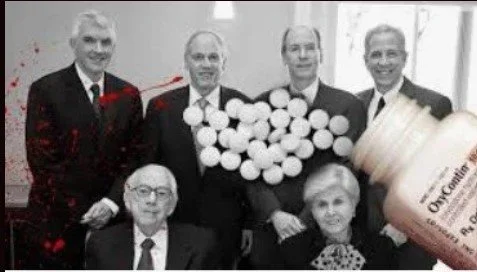
meet the Sacklers
Today, the Committee on Oversight and Reform will hold its second hearing to examine how the Sackler family caused Americas opioid epidemic, one of the deadliest public health crises in our Nation & history. We will hear how they researched it, how they planned it, how they manufactured it, how they sold it, how they marketed it, and, ultimately, how they profited billions from the sale of OxyContin. And we will hear also of the pain and suffering of the people who became addicted to it.
The FDA approved OxyContin in 1995 in spite of the fact that Purdue had conducted no clinical studies on how addictive or prone to abuse the drug might be. But Dr. Curtis Wright, the FDA examiner who approved the drug package insert for OxyContin which announced that the drug was safer than rival painkillers, because the patented delayed-absorption mechanism “is believed to reduce the abuse liability.” Wright left the agency shortly afterward. He later went to work at Purdue.

DOCTOR FOR SALE
DR. CURTIS WRIGHT
Sacklers Sacked But Purdue Still Caused Opioid Epidemic
Author information
Copyright and License information
PMCID: PMC9339402 PMID: 36036027
The role of Purdue Pharma and its blockbuster drug oxycontin in causing the opioid epidemic which has killed over 450,000 people in the past two decades has been well described in books like “The Empire of Pain” by author Patrick Keefe and in reports of investigative journalists that have appeared in leading U.S. newspapers.
From these and other sources it is estimated that in nearly one half of the cases drug addiction began with a doctor’s prescription. Although other drug companies and drug distributors were involved, Purdue with its blockbuster drug oxycontin was the leading supplier of prescription opioids to patients.
Purdue used “thought leaders” in medicine like Russell Portenoy, MD, Chairman of the Department of Pain Medicine and Palliative Care at Beth Israel Hospital in New York, to promote the safety of opioids. Purdue and other pharmaceutical companies paid large sums of money to Portenoy and his department. Purdue also paid many other physicians to tout the benefits of oxycontin.
Purdue also instructed its pharmaceutical representatives all over the country to tell physicians that oxycontin was not addictive primarily because of its slow-release properties. Purdue told its representatives to tell doctors that only persons with an “addictive personality” became addicts.
Contrary to the statements of Purdue recent evidence has shown that oxycontin is addictive and has played a significant role in the devastating epidemic of opioid addiction that has gripped the U.S. in recent years.
Private parties and states attorneys general have sued Purdue. Purdue’s response was to opt for a settlement and declare bankruptcy.
In the original bankruptcy proposal Purdue agreed to pay four billion dollars to plaintiffs. However, the Sackler family which privately owned Purdue, would be allowed to keep billions of dollars that it had withdrawn from the company before the bankruptcy was finalized. In December 2021 a different judge, Coleen McMahon of the District Court for the Southern District Court of New York, ruled that the previous judge’s ruling on the settlement should not go forward because it released the Sackler family, the private owners of Purdue from liability. The Sackler family, she noted, had withdrawn more than 10 billion dollars from Purdue between 2008 and 2018 as the opioid epidemic was worsening. This money was mainly deposited in off-shore accounts and trusts that were not accessible to Americans. This is where the litigation stands today.
All three of the original Sackler brothers who bought Purdue and ultimately developed oxycontin were physicians. At the peak of their sales and marketing, Purdue hired 3,000 doctors to serve on their speakers bureau—a fact which certainly does not reflect well on the medical profession. Richard Sackler, the current chairman of the board of Purdue and who closely directed the firm in recent years, went to Harvard Business School—a fact which also does not reflect well on America’s premier business school. At Purdue, profits trumped ethics.
The Sacklers were generous donors to universities, academic medical centers, museums, and other charitable institutions in the U.S. and all over the world. Their names adorned these venerable institutions. In almost every case their names have been removed. And with the new bankruptcy ruling the Sacklers will lose most of their vast fortune. Far more important is their tragic legacy of being a major cause of the devastating opioid epidemic which has afflicted so many American families.
I want to focus on one event that I believe was a real turning point in this story, and that is Purdue’s settlement with the Department of Justice in 2007. From 1997 to 2007, the Sackler family withdrew a total of about $126 million from the Purdue company. But then in 2007, Purdue reached a settlement with the Justice Department over criminal charges and pleaded guilty and paid a $600 million fine. Now, normally, when a company is forced to plead guilty to criminal charges, its owners and executive feel a sense of shame and they commit to cleaning up their act. But not the Sackler family. Instead, they doubled down, they continued their practices, and they took the 2007 settlement as a signal that they should withdraw even more money from Purdue in order to get out—as much money out as possible, as quickly as possible, and all so that they could prevent the money from going to the victims, the sufferers from the opioid crisis. According to documents filed in litigation starting in 2008, right after the 2007 settlement, Purdue distributed more than $10 billion to the Sackler family and the companies that they control