
Timeline of Purdue lawsuits


THANKS TO-Christine Minhee, OpioidSettlementTracker.com LLC.

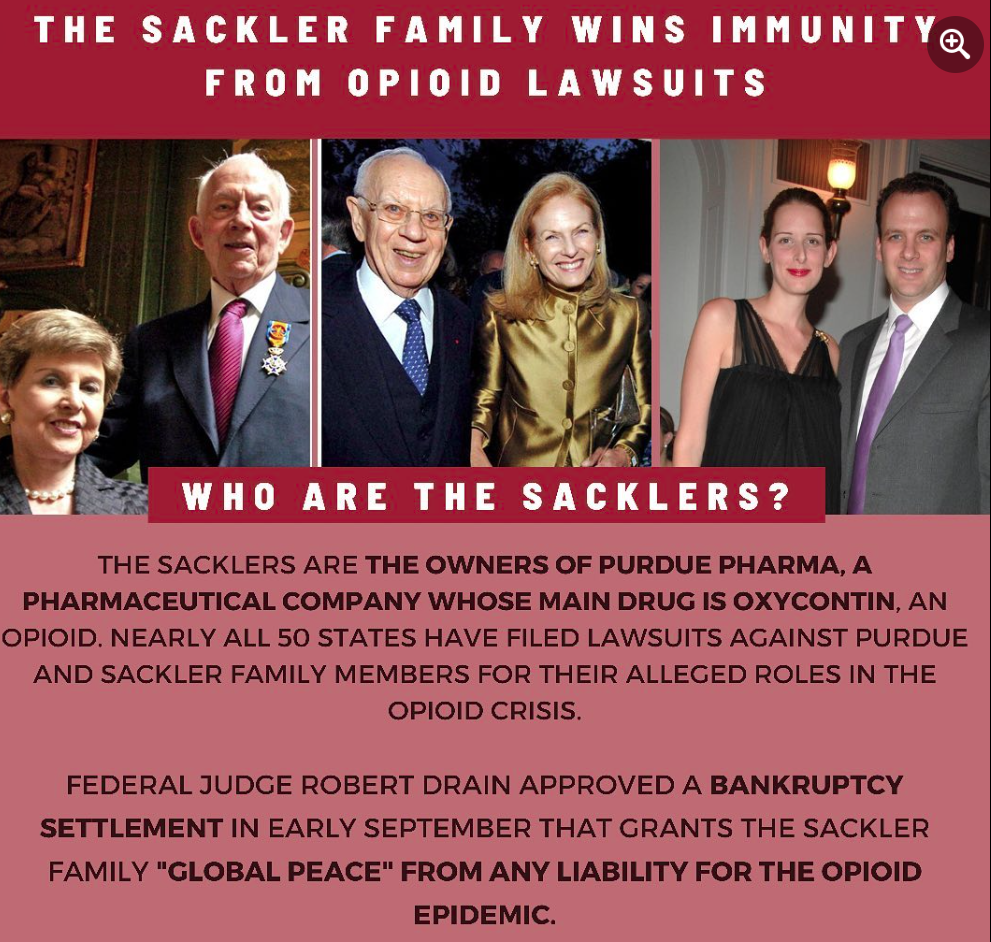
Sackler family, the maker of OxyContin, will be shielded from lawsuits as part of $6B settlement

Walmart offers to pay $3.1 billion to settle opioid lawsuits
The millennial generation of addicts alone could jump start the economy when returning to the workforce. I believe having a solid plan and investing into the needs of treatment and recovery is needed to recover from this crisis, and a better Pennsylvania that other states could be inspired from.
There’s finally billions of dollars being paid out from the settlements of lawsuits. I hope you can consider sponsoring a bill or start a conversation into changing the future for addicts and the people that love them. I believe they can recover but the journey will be long. The money that is to be received in the lawsuits should be dedicated to the people that didn't last to see the change, and hopefully their lives can help change laws and reunite families.
The Sackler family owners of Purdue Pharma LP reached a deal with a group of attorneys general to pay up to $6 billion in cash to resolve widespread litigation alleging that they fueled the U.S. opioid epidemic, bringing the OxyContin maker closer to exiting bankruptcy.
The attorneys general for eight states and the District of Columbia, who had blocked a previous settlement that included a $4.3 billion cash payment, announced the deal after weeks of mediation with the Sacklers.

Pennsylvania attorney general sues family who owns Purdue Pharma over its role in the opioid crisis
The $8 Billion Reckoning: 5 Shocking Revelations from the Purdue Pharma Settlement
The abuse and diversion of prescription opioids has precipitated a national tragedy of addiction and death, a corporate-fueled plague that has ripped through the fabric of American communities. In a historic admission of guilt, Purdue Pharma has finally confessed to a decade of systemic fraud and predatory marketing. The Department of Justice’s global resolution—a sprawling, multi-pronged effort involving over $8 billion in penalties—aims to dismantle the corporate infrastructure of the company while holding the Sackler family’s fortune to the fire.
However, as an investigative analyst looking past the headlines, the details of the settlement reveal a story far more disturbing than a simple fine. They uncover a corporate culture that viewed the Drug Enforcement Administration (DEA) as an obstacle to be bypassed and patients as mere data points in a high-stakes game of "recapturing sales."
1. From Corporate Giant to Public Benefit Company: A Calculated Gamble
In an unprecedented move that blurs the line between punishment and partnership, Purdue will cease to exist in its current form. Pending bankruptcy court approval, it will be resurrected as a Public Benefit Company (PBC). Under this structure, the company is no longer a private cash cow for the Sacklers but a trust-owned entity tasked with functioning in the public interest.
This "repurposing of assets" is a counter-intuitive approach to justice. The PBC is mandated to deliver prescription drugs safely and provide steep discounts on life-saving overdose rescue drugs and Medically Assisted Treatment (MAT) medications. Most significantly, the DOJ is essentially discounting the company’s punishment; they are willing to credit up to $1.775 billion of the $2 billion criminal forfeiture based on the value conferred to state and local governments through this new structure.
From a policy perspective, this is a massive gamble. The government is effectively betting that the same infrastructure used to fuel the crisis can be inverted to solve it. Skeptics, however, must ask: is this true accountability, or has the government simply become a primary stakeholder in the continued production of opioids?
“With criminal guilty pleas, a federal settlement of more than $8 billion, and the dissolution of a company and repurposing its assets entirely for the public’s benefit, the resolution in today’s announcement re-affirms that the Department of Justice will not relent in its multi-pronged efforts to combat the opioids crisis.” — Deputy Attorney General Jeffrey A. Rosen
2. Gaming the DEA: Fraud for Higher Quotas
Between May 2007 and March 2017, Purdue engaged in a "dual-object conspiracy" to defraud the United States. The mechanism of the fraud was as sophisticated as it was lethal: Purdue lied to the DEA about the efficacy of its anti-diversion programs to manipulate manufacturing limits.
By reporting misleading data—which included prescriptions from doctors Purdue knew were likely diverting pills—the company successfully requested higher manufacturing quotas. This allowed Purdue to flood the market with a volume of OxyContin that far exceeded legitimate medical need. The irony is staggering: Purdue presented itself as a partner in compliance while simultaneously using "dirty" data to ensure more pills reached the street, effectively weaponizing the regulatory process to fuel the epidemic.
3. Visiting "The Candyman" 300 Times: Profit Over Patients
Perhaps no single detail illustrates the rot within Purdue’s internal culture more than its relationship with a physician known to patients as “the Candyman.” While patients whispered about the doctor’s "crazy dosing of OxyContin," Purdue’s sales team saw only a high-value asset.
Despite clear red flags of diversion and unsafe prescribing, Purdue sales representatives visited this "Candyman" more than 300 times. This wasn't a failure of oversight; it was a deliberate choice to ignore medical reality in favor of volume. This relationship exemplifies a culture that viewed the "devastating ripple effect" of addiction as a secondary concern to the bottom line.
“Purdue, through greed and violation of the law, prioritized money over the health and well-being of patients. The FBI remains committed to holding companies accountable for their illegal and inexcusable activity and to seeking justice, on behalf of the victims.” — Assistant Director Steven M. D’Antuono
4. "Evolve to Excellence"—The Sackler Strategy of Doubling Down
The investigation highlights that the "Candyman" was not an anomaly; he was the intended target of a top-down strategy directed by the Sackler family itself. In 2013, as the legitimate market for opioids began to contract, the "Named Sacklers"—specifically Richard, David, Mortimer D.A., Kathe, and Jonathan Sackler—refused to accept a decline in profits.
Instead, they personally requested and approved a marketing program titled “Evolve to Excellence.” The logic was predatory: Purdue "intensified" its marketing toward extreme, high-volume prescribers who were already writing OxyContin scripts at a rate 25 times higher than their peers. The Sacklers pushed their executives to "recapture lost sales" by ensuring these doctors prescribed opioids for uses that were medically unnecessary and highly susceptible to abuse. The $225 million the family will pay to resolve these civil claims is a drop in the bucket compared to the wealth generated by this aggressive "doubling down" on the most dangerous segments of the market.
5. High-Tech Kickbacks: The Digital Evolution of Greed
The conspiracy also reveals a modern, insidious evolution of the traditional kickback scheme. Between April and December 2016, Purdue paid "digital kickbacks" to Practice Fusion Inc., an electronic health records (EHR) company.
This wasn't just a backroom deal; it was a technological infiltration of the doctor-patient relationship. In exchange for payments, Practice Fusion’s software was designed to pop up recommendations for Purdue’s extended-release opioids (OxyContin, Butrans, and Hysingla) directly at the point of care. By embedding their marketing into the very software doctors used to make clinical decisions, Purdue bypassed traditional medical skepticism, turning a diagnostic tool into a sales platform. This represents a chilling new frontier in corporate malfeasance, where algorithms are tuned to prioritize profit over patient safety.
Conclusion: A Sad Chapter, but Not the End
The $8.3 billion resolution is a staggering sum, yet it remains a partial victory. While the corporate entity has admitted to felony crimes, the resolution does not release individuals—including the Sackler family or Purdue executives—from potential criminal liability.
The DEA states that this "closes a particularly sad chapter" in the opioid saga, but for the millions of families impacted, the book is far from shut. As Purdue transitions into a Public Benefit Company, we are left with a haunting question: Can a corporate structure born from a decade of fraud and "crazy dosing" ever truly act as a steward of the public health? While the assets have been repurposed, the damage remains a permanent scar on the American landscape.
“Through our negotiations with Purdue Pharma, it became crystal clear the Sacklers have no intention of taking any ownership for engineering an epidemic that claims the lives of 12 Pennsylvanians each day,” Shapiro said in a release Thursday morning. He wrote that his lawsuit would “require this family of billionaires” to “take responsibility for the pain they caused.”